Career Framework
Health NZ Allied Scientific and Technical Career Framework

Introduction
Pay equity for most Te Whatu Ora Allied Scientific and Technical practitioners was settled in September 2023. The final settlement resulted in significant increases for some Allied, Scientific and Technical professions, with five professions receiving nothing as they were deemed to not be undervalued based on sex (MRI & NM Technologists, Sonographers, Psychologists, Perfusionists and Medical Physicists).
Since pay equity translations had been a blunt tool, some Designated roles within the same profession had been placed differently depending on the prior salary step. Work has since been in progress to improve the correct placement of members on Designated salary scales. The Career Framework and Interim Career Framework – described below – only applies to those in Designated roles.
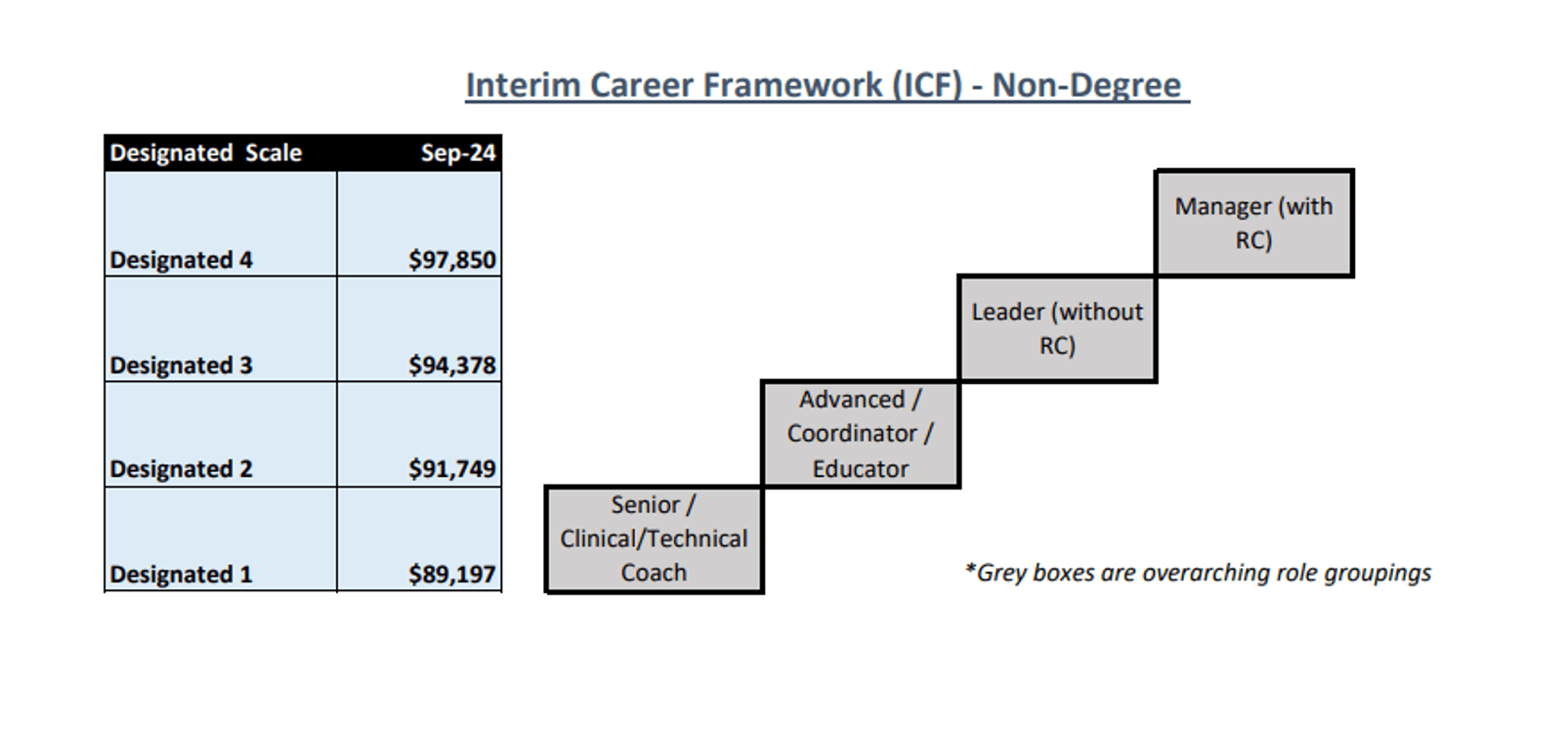
Interim Career Framework (ICF)
In early 2024 it was agreed that an Interim Career Framework would be implemented prior to the final career framework. This was meant to be a quick halfway house, that should have been implemented early 2025, however work on this has been stalled with the employer now signalling affected staff in Degreed and Non-Degreed/Technical designated roles will be advised of outcomes by early June 2026.
You can find more information about the ICF below.
In December 2025, Health NZ also ran staff webinars on the ICF roll out for the Degreed roles. Find here a recording of the webinar, along with the accompanying slide deck below.
A Health NZ webinar was also run in May 2026 for staff in Non-Degreed/Technical roles.
INTERIM CAREER FRAMEWORK RESOURCES
Click below to view the Interim Career Framework materials.
Interim Career Framework FAQs
Mapping considerations
What are the mapping considerations?
The mapping process considers the requirements of the role, these may include
- Responsibilities of the role
- Size of the district
- Size of the team
- Responsible Centre holder
- Relativities within regions
Roles and responsibilities
Who leads the mapping process at a district level?
To help ensure consistency at district level, the district Chief Allied Health Officers will have oversight of the mapping process.
Who else is involved in confirming mapping?
CAHST/their office will work with Operations Managers, with input from line managers and unions. HR support is needed, and BI support may also be required.
Scope
Does my current job title determine whether my role is designated or where it fits on the ICF?
No. Current role titles are not used to determine designation or ICF placement. The ICF implementation is for roles that are already designated, with a designated position description. Each role is assessed against the framework on its actual functions and scope.
I do work that is outside my position description and in the past, I’ve completed merit/CASP, will this extra contribution be recognised?
The mapping is based on service need and the requirements of the role, not the capability of the person in the role.
The progression rules and the Guidelines of Expectation of Professional Practice (GEPP) in the pay equity settlement replace any previous Merit and CASP systems that were in place prior to settlement.
Can mapping be used to create new designated roles?
No. This is not a service design process and is not a mechanism to create new designated roles; the process is limited to mapping existing designated positions to the ICF.
Could mapping my role to the ICF mean I go down in grade or pay?
No. No individual will have their pay reduced as a result of mapping roles to the ICF. If your role is mapped to a lower grade, your current salary will be held until the rates of the correct band exceed your salary.
What happens to roles that were already scoped before the ICF?
These are mapped to the equivalent role within the ICF to ensure consistency.
If a role becomes vacant, can the mapping be reconsidered?
Yes. Whenever a role becomes vacant, the service needs and role requirements may be reviewed, if the position description is changed, mapping may need to be reconsidered.
What if mapping results in a higher designated grade for my role?
If mapping leads to upward movement, the individual will begin at step 1 of the new grade with anniversary dates taken into consideration.
How is rural working recognised in the ICF?
Rural working requirements are considered within each role rather than being treated separately.
Has Appendix G for Hauora Māori roles been updated?
Appendix G has now been given the name – He Awa Tārai. A hui relating to this is planned for the week of the 14th December and more information will be uploaded to Te Haerenga following this hui.
What if the specified grades in the Collective Agreement differ from ICF mapping?
Collective Agreement grade specifications take precedence over ICF mapping for particular roles.
Is there progression criteria for designated roles?
There is no merit progression through the Designated steps. Progression through the steps within each grade is on an annual basis, on the employee’s anniversary date. Progression does not occur beyond the top step of each grade.
Quality assurance
How is consistency supported across regions?
Regional or district-sized forums will be used for sense-checking mapping decisions
How will national consistency be ensured?
A national forum will be established for sense-checking and moderation of decisions.
Is there a reconsideration process if someone disagrees with mapping?
Yes. A national reconsideration process will be in place.
Where can I get more information?
We will communicate more information as we work through the implementation process. You can also speak to your manager or your union delegate.
Career Framework
Since mid-2024 a job evaluation working group has been undertaking a programme of work to develop a fit-for-purpose job sizing tool for placement of those on Designated salary scales. We jointly agreed to use a modified version of the NHS’s Agenda for Change tool, adapted to Aotearoa’s specific cultural context, the name that has been chosen for the tool is the ‘Job Evaluation Tool or JET’.
Below is a summary of the project plan, as of December 2025.
Progress on this has also been slow. As you can see from our current status on the project plan, training of our panellists (a mix of Health NZ staff members in Designated roles and HR personnel) is due to begin within the next few months. A similar framework will also be rolled out for those in Technical Designated roles, in a parallel process.
In January 2026 we received confirmation from the employer that the pilot phase of this work will soon kick off. Around 450 roles will be evaluated (which includes 220 allied, scientific and technical roles) in this pilot, and this will inform any revisions that need to be made to the final tool and process. You can find more information on the pilot in the slide deck below.
We will send out updates on this work in APEX newsletters as soon as we know more, so look out for these over the upcoming months.
Career Framework Resources
GEPP
Download
Settlement FAQs
Download
Translation Document
Download
In Principle Settlment Agreement
Download
Have Career Framework questions?