Health & Safety

Improving and protecting our health and safety at work.

Introduction

Improving and protecting our health and safety at work is a massive part of what we do as a union.

Unions provide a balance in the workplace and help address the inherent inequality of power in employment relationships and nowhere is that more important than when it comes to protecting the safety of our members and others in the workplace (including patients, visitors and students).

We provide support and advice on the full range of health and safety issues you will come across at work: understaffing, fatigue, bullying and harassment, hazardous materials, radiation risks, RSI, moving and handling, high caseloads, infectious diseases and occupational stress.

We are committed to ensuring safe workplaces and ensuring health professionals are empowered to look after the safety of their workplaces and themselves.

Your rights at work

APEX in the Health & Safety Space

Our collective agreements contain health and safety provisions including:

  • Limits on hours of work and minimum rest periods;
  • Provision of protective clothing and equipment;
  • Support for employees on ACC;
  • Meal and rest breaks;
  • Provisions to prevent bullying and harassment;
  • Agreements on workloads, rostering and/or staffing.

Your APEX delegates, advocates and health and safety representatives are available to assist you on all matters related to health and we give advice and support to APEX health and safety representatives. Contact us for more information.

APEX runs annual health and safety training for health and safety representatives and delegates. Our last training covered:

  • Health and safety systems;
  • The big 4 tools for HSRs – health and safety committees, incident reporting, PINs and ceasing unsafe work;
  • Risk assessment;
  • Bullying and harassment;
  • Case study of unsafe practice in a pathology laboratory; and
  • Designing health and safety interventions.

If you have an interest in Health & Safety and are not yet a representative, get in touch with us at events@apex.org.nz. Becoming a Health & Safety representative will ensure that you are kept up to date with news in the Health & Safety space, as well as giving you a chance to register for APEX Health & Safety training next year.

Health & Safety Handbooks


Understanding Burnout

What is burnout?

Burnout is fatigue and exhaustion caused by workplace stress.

The eleventh International Classification of Diseases defines burnout as the result of chronic workplace stress which has not been successfully managed. It is characterised by three dimensions:

  • feelings of energy depletion or exhaustion;
  • increased mental distance from one’s job, or feelings of negativism or cynicism related to one’s job; and
  • a sense of ineffectiveness and lack of accomplishment.
How common is burnout?

Surveys of medical and health professionals have found over 50% experience burnout or symptoms of burnout.

When are you most at risk?

According to a UK study of 2,000 working adults in 2020, the average age a person will now experience burnout is 32.

How do you measure burnout?

The Copenhagen Burnout Inventory measures burnout by asking questions relating to personal, work and patient/client related feelings including:

  • How often do you feel tired?
  • How often do you feel worn out?
  • Are you exhausted in the morning at the thought of another day at work?
  • Is your work emotionally exhausting?
  • Does it drain your energy to work with patients/clients?
  • Do you sometimes wonder how long you will be able to continue working with patients/clients?
What causes burnout?

Burnout can be caused by a range of factors including personal, social, service or organisational problems. Common causes include:

  • Unmanageable workloads
  • Unclear job boundaries
  • Unreasonable time pressure
  • Lack of support from managers
  • Inadequate communication
  • Unfair treatment including bullying, favouritism and discrimination
  • Factors outside work such as parental responsibilities or home stress
  • Personality traits such as perfectionism
  • Inadequate personal coping mechanisms
  • Team atmosphere or distrust
  • Micromanagement or lack of autonomy
  • Low pay
  • Fatiguing rosters
  • Traumatic work
  • Lack of appreciation from managers or patients/clients
  • Not getting enough sleep, nutrition, rest, or time away from work
What can you do to prevent burnout yourself?
  • Exercise – reduces the level of cortisol the hormone caused by stress.
  • ‘Me time’ – setting aside a couple of night a week for time away from work.
  • Avoid unhealthy habits – don’t rely on alcohol, sugar, smoking, screen time or caffeine to cope.
  • Take control – make a plan for your wellbeing, remaining passive is part of the problem.
  • Connect with people – laughing and spending time with friends relieves stress.
  • Prioritise – not all your tasks will make a real difference, and your inbox will always be full.
How to Prevent Burnout in the Workplace
  • Rostered recovery days; where appropriate rosters should include days off to compensate for working over nights and weekends.
  • Agreed workloads; workloads should be agreed, not imposed. Maximum workloads should be set as guidelines including through the use of staff to patient/client ratios; guidelines on caseloads; and tasks per shift.
  • Fair remuneration; salary and allowance rates should be fair, equitable and at a level which values the employees work including degrees of effort, skill, responsibility and risk.
  • Protected tea and meal breaks; rest and meal breaks should be protected and if employees are required to work through them because of emergency work, the time should be allowed in lieu.
  • Support for taking leave; employees should be encouraged to take annual leave at times when they can have rest and recreation and be supported to take sick leave when unwell.
  • Adequate supervision and safe communication; good teams will ensure everyone knows what the challenges and goals are; and employees are safe to discuss concerns and raise questions with their supervisors.
  • Structured professional development; Opportunities to learn, carry out research and engage in meaningful high level work is built into the system.
  • Employees are empowered; During service planning and decision-making employees are empowered to lead change.
  • Change is mapped: The world is not going to stop changing so our workplaces need maps for planned change and everyone’s role within it.

Fatigue Management & Minimisation

Te Whatu Ora’s fatigue management and minimisation steering group have published three guides for night shift workers, which reflect the principles to:

  • provide accessible and nutritious food options for night workers;
  • ensure staff have access supportive systems for napping, as an evidence-based means to reduce fatigue, for night workers;
  • provide supportive transport options for fatigued workers.

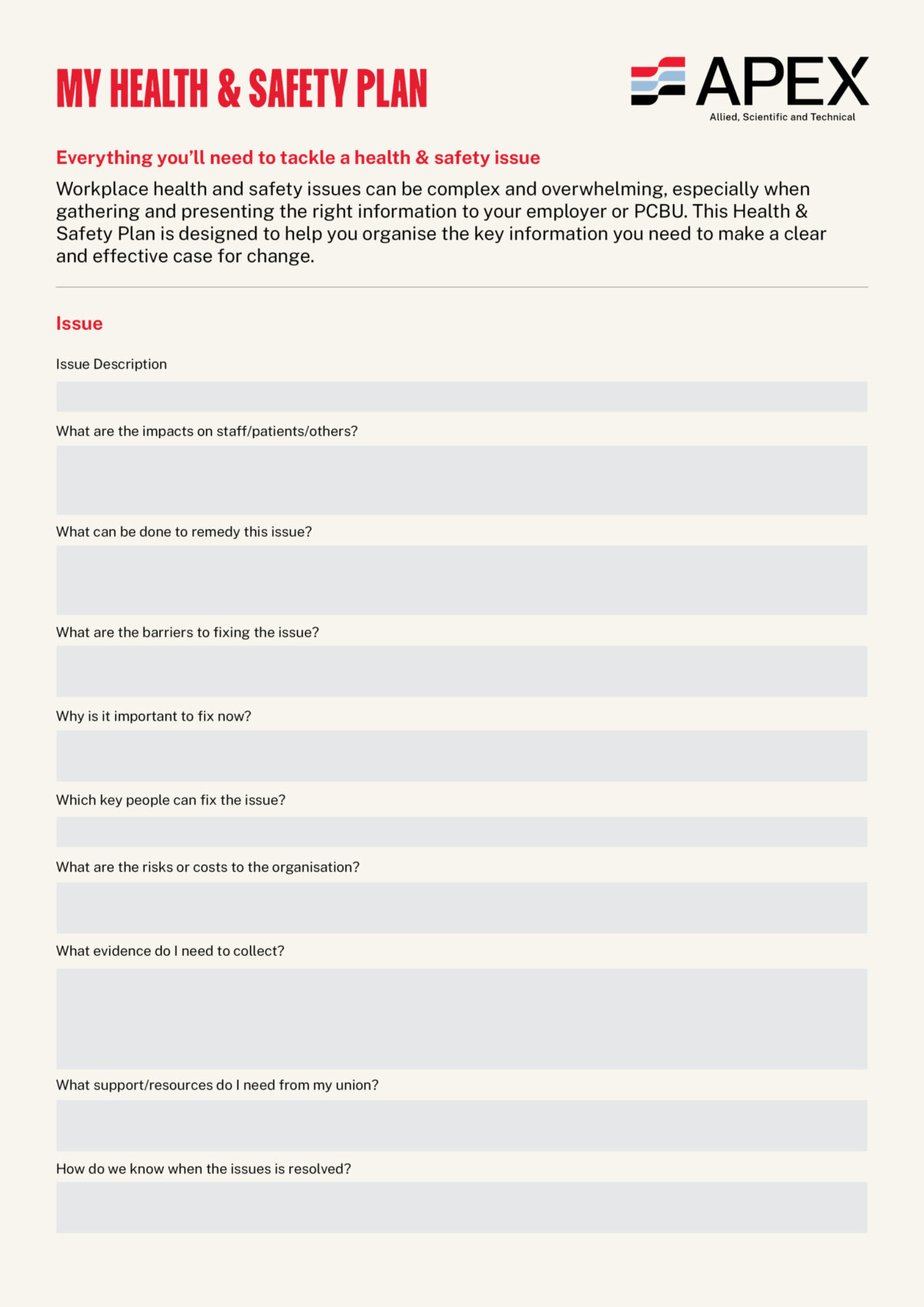
My Health & Safety Plan

Health & Safety issues in the workplace can be complicated with many moving parts. It can be overwhelming gathering and presenting the relevant information to your employer/PCBU. This Health & Safety Plan is designed to get you thinking about the information you will need in order to present an effective case for change.
Report a Health and Safety Issue

Your Details

Your Health & Safety Reps